
2026-09-13
Chemical jerry steam finish
Wide-mouth tunnels for cleaners that hate wrinkled sleeves.
Chemical jerry steam finish
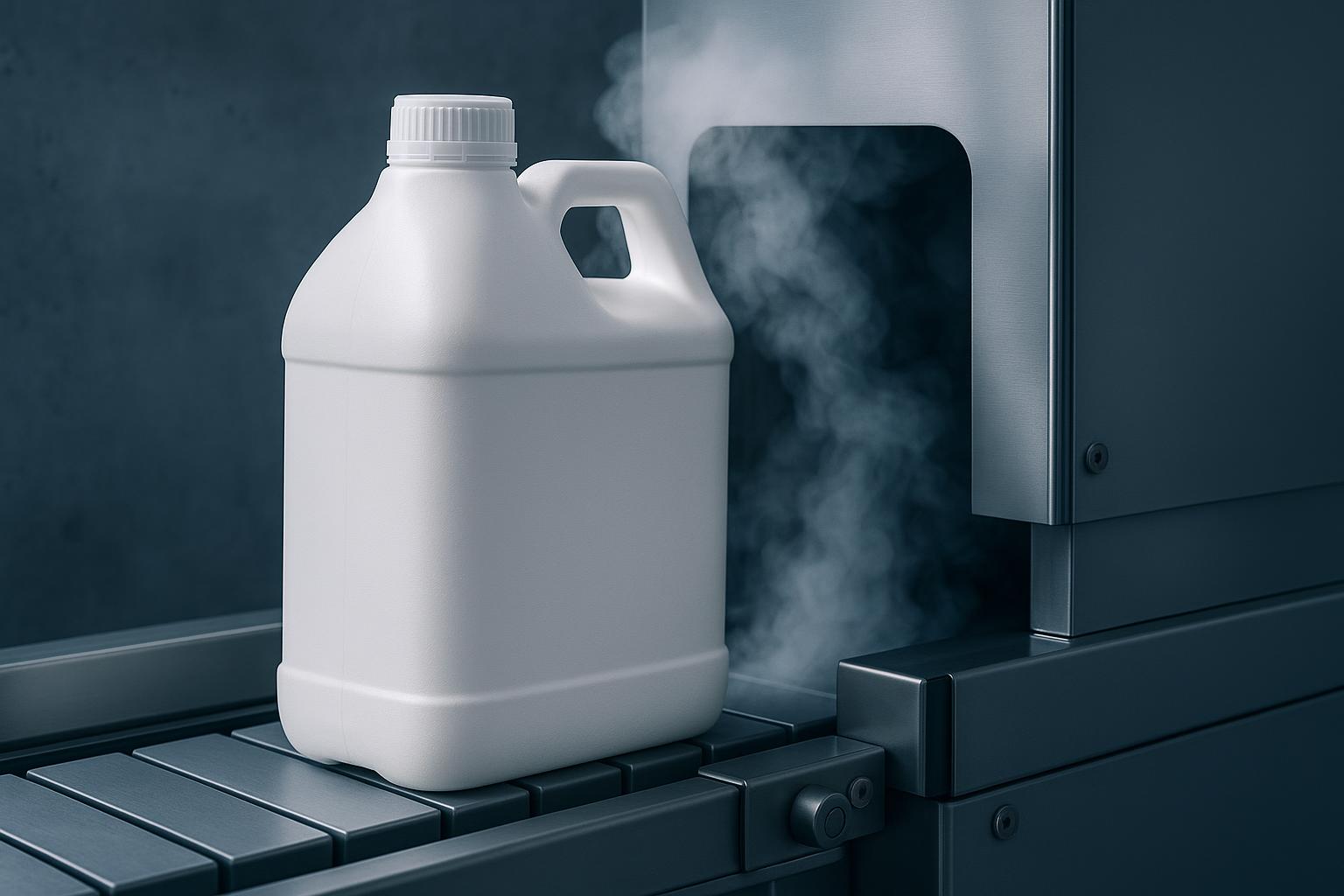
Chemical jerry cans expose steam sleeve faults around the handle recess, square shoulder and broad cap skirt. A band can look tight on the cap while condensate sits in the handle well and later wets cartons, coding belts or pallet sheets. Judge the finish on shrink, tear perforation and dry-off, not only on a neat neck band at the tunnel exit.
Why jerry cans stay wet
Most chemical and oil plants run HDPE jerry cans with moulded handles, wide shoulders and 28 to 45 mm necks. Steam shrinks PVC or PET-G around those shapes, then condenses on cooler plastic and rails. In Durban, Gqeberha and other coastal plants, humid air slows the dry-off, so droplets remain after the sleeve has gripped the cap.
Bottle pitch changes the result. When rectangular jerry cans run too close together, one shoulder shields the next pack and the tear perforation can wrinkle. When pitch opens too far, dwell shifts away from the trial setting. On Steam Tunnel L, the larger steam chamber suits jerry and gallon packs, provided the side guides hold each container square through the hot zone.
Set the sleeve before chasing steam
Start with sleeve fit. Measure the supplied sleeve against the cap skirt on filled sample jerries, then choose a cut height that keeps the lower edge off the shoulder radius and carries the top edge over the tamper band. Put the tear perforation on the side the operator naturally grips, with enough shrink left for a straight pull after the tunnel. Use the band sleeve size guide to compare cap and band choices when the same jerry body runs with more than one closure supplier.
Run the first packs at low steam pressure and a steady pace. Raise pressure until the sleeve relaxes around the cap, then use dwell to remove shoulder wrinkles. Watch for a glassy, over-wet sleeve near the tunnel exit, which usually points to too much steam or poor exhaust. Stop at the first setting that gives a straight perforation line and no bottom-edge fish-mouth.
Control condensate and keep the tunnel dry
Condensate control starts with drains, hood seals and exhaust direction. A leaking hood gasket can wet one shoulder more than the other, leaving one side wrinkled while the far side looks finished. Chemical residue also hardens rubber around the hot steam chamber. During jerry changeovers, check the steam hood seal for cuts, swelling and flattened corners, especially after caustic cleaner or solvent-based product runs.
Sleeve placement must repeat pack after pack. Skew at the feed point becomes a diagonal tear strip after shrink, more visible on rectangular jerry cans than on round bottles. Clean sleeve guides, remove offcuts and set stop fingers against the cap centreline. Where operators swap between 2 litre, 5 litre and gallon containers, mark tray position and bottle pitch on the changeover sheet.
Record the setting, then prove it on the outfeed
Record the closure supplier, neck size, sleeve grade, lay-flat measurement, cut height, tear-strip position, steam pressure, dwell setting, bottle pitch and the point where the handle recess is dry. Add a note when coastal humidity is high or when the line starts after a wet washdown. The steam start checklist gives setters a practical sequence for warm-up, drains, first packs and outfeed inspection.
A typical 5 litre degreaser line starts with a 38 mm cap and a tall tamper band. The first sleeve sits too low, grips the shoulder and pulls the tear line into a spiral. The setter shortens sleeve height, opens pitch by one jerry width, raises steam pressure slightly and increases dwell. Wrinkles clear, but droplets still sit in the handle recess. The team improves exhaust draw, checks the hood seal and records dry-off at the third rail post. For jerry sleeve trials, send cap size, sleeve sample, container photos and running pitch through our contact form.
What our Bottle Sealing customers say
Verified Google reviews